
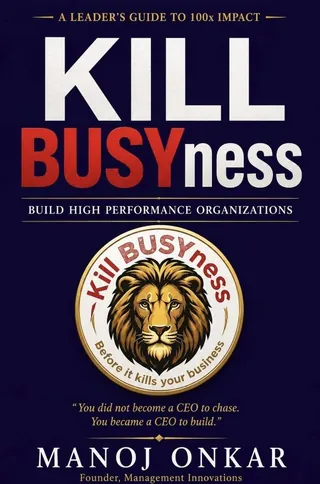
Concept Videos — All 11 Chapters
Explore the core concepts of KILL BUSYness narrated by author Manoj Onkar. Available in both 16:9 Widescreen HD and 9:16 Vertical Short formats.
The Blind Spot of 100 Years of Management
The belief that leadership's job is simply to extract maximum output from people as resources. When you treat humans as consumable resources, output surges initially... but the human foundation hollows out.
- 100-Year Blind Spot: Managing people as consumable resources.
- The Withdrawal: When treated as resources, people quietly withdraw.
- The Source Shift: Transform human energy into genuine co-creation.
The BUSYness Mirror
Are you building a High-Performance organization... or just a BUSY one? Most leaders know something is wrong before they can name it: ending weeks with dozens of meetings with little real progress.
- The Cycle: Unclarity -> Overactivity -> Diluted Resources -> Shallow Results.
- Visibility Trap: Meetings consume hours with few concrete decisions.
- Follow-Up Rhythm: Leaders spend 8-12 hrs/week chasing status updates.
Purpose Fills the Void
What happens to an organization when genuine purpose is absent? BUSYness immediately rushes in to fill the void. A true purpose is a decision-making filter to say NO to distractions.
- The Void: Without purpose, busyness becomes the default operating mode.
- Plaque vs Filter: Purpose is not a slogan; it is a decision filter.
- The Power of Saying NO: Rejecting distractions to focus on what matters.
Strategy Is Business
Confusing a lengthy operational to-do list with actual strategy. A strategy that tries to do everything is not a strategy—it is a recipe for dilution and exhaustion.
- To-Do List vs Strategy: Doing everything guarantees mediocre results.
- Explicit Trade-offs: Strategy is choosing what NOT to do.
- Focused Allocation: Concentrate energy where you have decisive advantage.
The Competency Chain
When individual contributors become managers without developing managerial competencies, they default to doing the work themselves. A manager must operate as a CEO proxy.
- The Promotion Trap: Top performers defaulting to micro-management.
- The Broken Link: Execution breaks when managers do instead of lead.
- Manager as CEO Proxy: Leading capability development at every level.
The ROAR Model: Reflection
Without reflection, organizations keep solving the exact same problems quarter after quarter. Reflection is rigorous operational examination to dismantle systemic causes of friction.
- The Symptom Trap: Solving the same problems quarter after quarter.
- The ROAR Model: Transforming reflection into operational power.
- Systematic Diagnosis: Treating root causes instead of surface chaos.
The Follow-Up Tax & True Ownership
Senior leaders spend 8 to 12 hours every week chasing updates and following up on missed deadlines. Ownership means eliminating the follow-up operating rhythm and creating radical peer accountability.
- The Follow-Up Tax: 8-12 hours per week lost to status chasing.
- False Reliability: Needing reminders is a symptom of broken ownership.
- Radical Accountability: Commitments kept without chasing.
Leadership Creates the Culture
Culture is defined by what leaders tolerate and what they consistently model. If senior leadership is constantly frantic, late to meetings, and running on escalations... that frenzy cascades across the whole company.
- Culture is Tolerated Behavior: Not slogans, but daily modeled standards.
- The Frenzy Cascade: Frantic leaders create frantic organizations.
- Momentum Cannot Be Delegated: Leadership sets the pulse of flow.
Assert the Standard
Holding the standard even when it is inconvenient, costly, or unpopular. The moment an organization compromises a standard, a new lower standard is silently created.
- The Silent Lowering: Tolerating slips creates a permanent lower bar.
- The Cost of Standards: Holding the line when inconvenient or unpopular.
- Non-Negotiable Baselines: Consistency across onboarding and delivery.
Building the High-Performance Architecture
Transformation happens through architecture, not motivational speeches. Designing an operating rhythm that eliminates busywork and maximizes flow velocity in the first 90 days.
- Architecture Over Speeches: Systems drive behavior, not pep talks.
- Operating Rhythm Reset: Rebuilding meetings and execution cadences.
- The 90-Day Blueprint: Practical roadmap to dismantle busywork.
Sustaining Greatness: Velocity Over Speed
Speed is running fast in random directions. Velocity is speed with decisive direction. Sustaining greatness means continuous hygiene: systematically killing busywork as you scale.
- Speed vs Velocity: Movement in random directions vs focused direction.
- The Gravitational Pull: Preventing the slide back into comfortable busyness.
- Continuous Hygiene: Systematically killing busywork as you scale.