
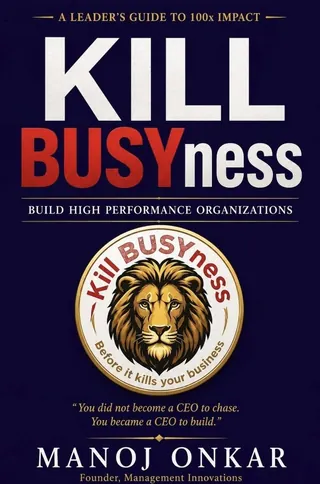
Assert the Standard
This is the Assert move of ROAR: having seen and owned the reality, the leader now sets non-negotiable standards, for themselves first and then for every level of the organization. The chapter's governing idea, drawn from Edgar Schein's research at MIT, is that culture is shaped by what leaders consistently pay attention to, measure, and react to under pressure — not by what they say. The organization doesn't do what the CEO says; it does what the CEO does. The book draws a sharp line between ego-centric and eco-centric leaders. Ego-centric leaders demand compliance, enforce through fear, and see the culture they built revert the moment they leave the room. Eco-centric leaders demand excellence by holding the standard first themselves, and the culture they build outlasts their tenure. Two contrasting real cases make this vivid. Dr. Raghavan, a brilliant, ambitious conglomerate chairman, had built an organization so dependent on him that his own CEOs described themselves as executors of his vision rather than leaders in their own right; a breakthrough came when he admitted, "I thought I was being a strong leader. I was actually being a bottleneck," and shifted toward genuine co-creation — decisions that once took weeks began taking days because they no longer had to route through him. Sunil, an equally intelligent peer, absorbed every framework intellectually, sent his whole team to leadership programs, but never once located the problem in his own behavior — producing an organization of capable, frustrated leaders too afraid to propose their own ideas. From this distinction the book derives four non-negotiables that form the CEO's personal promise to the organization. No Follow-Up Required, detailed in Chapter 6, is the first. The second is world-class best practice in every function, not "good enough for our size" — illustrated by Rajiv's 21-day training "boot camp" at a premium training company, where quarterly audits and re-certification never stop, because excellence there is simply the entry requirement, not a goal. The third is breaking the silo: at a Karnataka tech company, weekly leadership meetings had become a blame war between Sales, Engineering, Operations, and Finance until the CEO, Kumar, drew a circle on the whiteboard and said, "This circle is our company — we're either one team or we're nothing," a moment that names three hard truths: if you're married to your department you're divorced from the company, departments are just a work-distribution mechanism, and there are no successful departments inside a failed organization. The fourth non-negotiable is treating people as source, not resource — illustrated by an Indian multinational's MD who, facing pressure to restructure quickly, instead spent eight full months developing his leadership team's mindset and capability before making a single structural change, because global research shows organizations that invest seriously in people development see 11% greater profitability and are twice as likely to reach the top quartile of financial performance. These four non-negotiables are sustained by one personal discipline: the CEO begins every meeting by connecting the conversation back to purpose and strategy, using both as a living go/no-go filter for every decision. Applied consistently, the behavior propagates without instruction — leaders at every level begin testing their own proposals the same way. With the standard now asserted, what remains is building it into a structure durable enough to survive without the leader's constant personal attention — the twelve-phase implementation plan that Chapter 9, Build, lays out in full. The chapter's closing exercise, the Personal Covenant, asks each leader to review the four non-negotiables — No Follow-Up Required, world-class best practice in every function, breaking the silo, and treating people as source rather than resource — and commit, in writing, to one visible change in the next seven days that the team would notice without being told about it. The book is unambiguous about the order of operations here: none of these four standards can be delegated to a policy document or an HR initiative and still work, because the entire premise of Assert the Standard is that culture is built from what a leader visibly does under pressure, not from what gets written down. Dr. Raghavan's transformation and Sunil's stagnation are placed side by side deliberately — both men had access to the same frameworks, the same consultants, the same language, and only one of them was willing to locate the problem inside his own behavior. That willingness, more than intelligence or ambition, is what the chapter argues actually separates the two outcomes.
Where, specifically, do you personally get a pass on a standard you expect everyone else in your organization to meet?
Log in to save your private reflection and earn XP.