
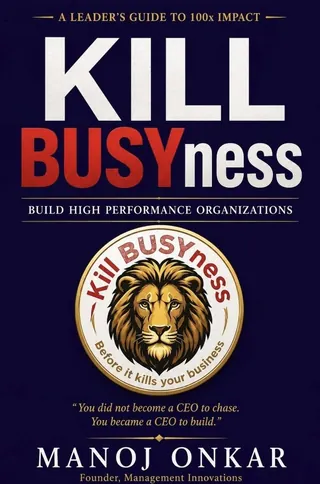
Management Innovations — Vision to ImplementationKILL BUSYness — the book, front cover
KILL BUSYnessKILL BUSYness

← All Chapters

Chapter 07 · ROAR: Own

Leadership Creates

Leadership creates — it brings new realities into being: a culture, a standard, a future that existed only as potential until a leader chose to build it. Citing John Kotter's research, the book argues most organizations are overmanaged and under-led; the missing ingredient isn't talent or management competence, but the deliberate choice to create rather than merely optimize. That choice requires breaking three comfort zones. The first is past ways of working — the methods that built early success calcify into walls, and the organization defends its methods instead of serving its mission. Drawing on Robert Kegan and Lisa Lahey's "Immunity to Change," the book catalogs the excuses that protect the status quo: "this is how we've always done it," "we're too busy right now," "we tried this before," "our customers haven't asked for it" — each one worth challenging directly. The second comfort zone is silos and hierarchy: structures that once created focus now prevent the collaboration the next stage demands. A trading company's business units, each fiercely autonomous and successful for years, turned out to be independently pitching the same clients without realizing it — the very structure that built the company's strength had made it invisible to itself. The third comfort zone is past success itself: one CEO involved 500 leaders directly in reshaping strategy rather than handing them a finished document, producing not just a plan but 500 people who understood the reasoning and could carry it into every room the CEO could never personally reach. Organizations that disrupt their own paradigms before the market forces them to consistently outperform those that wait to be broken by someone else. Creating the future requires protected time for it — not symbolic time, but real structural commitment. One Karnataka-based MD and director block one full day a week purely for building the future rather than managing the present; a Mumbai leadership team has progressively moved toward three such days a week. What separates these leaders isn't spare capacity — everyone in the book has a full calendar — it comes down to intention. And the momentum of change can't be delegated: the moment a leader steps back before a new culture is fully embedded, the gravitational pull of the familiar reliably reclaims the space. The most ambitious leaders move from building a company to building an ecosystem — where customers become co-creators rather than transactions, and suppliers become collaborators rather than adversaries to be managed down on price. The question shifts from "how do we win our share of the market?" to "how do we help create a larger one?" One educational institution illustrates this: rather than remaining a well-run school, it built a platform of franchisees, coaching partners, ed-tech providers, and parent-education programs — each partnership expanding its reach without requiring it to own and control everything. Ultimately, the leader's choice is never made in one dramatic moment. It is made in a hundred ordinary ones — every meeting, every decision about what to accept and what to challenge. Every morning offers the same two options: manage the existing reality, or create the new one. A leader who chooses the second option daily, not heroically but repeatedly, is what produces a High-Performance Organization — and having made that choice, the next move of ROAR is to assert the standard it requires. The chapter's exercise asks leaders to keep a simple running log for one week — every significant decision or conversation marked M for Managing the current reality or C for Creating a new one — turning an abstract idea about leadership orientation into an honest, countable pattern. The Mirror Question that follows is pointed: how many times this week did you choose the familiar path over the one that would have required you to build something genuinely new? The book's deeper argument across all three comfort zones is that none of the old patterns — defending past methods, protecting silo boundaries, treating past success as a ceiling rather than a floor — were ever wrong when they were built. They were exactly right for the organization that existed then. The work of leadership is recognizing, again and again, the moment a structure that once created strength has quietly become the thing standing in the way of what comes next.

Where has your organization already started drifting back toward an old default the moment you stopped personally pushing for the new one?

Log in to save your private reflection and earn XP.