
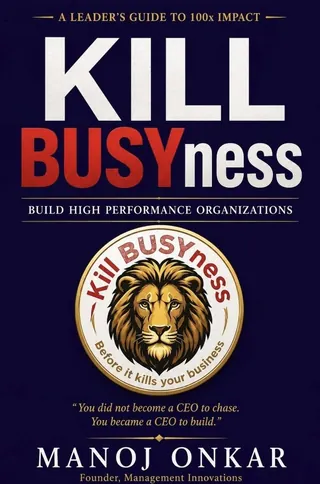
Management Innovations — Vision to ImplementationKILL BUSYness — the book, front cover
KILL BUSYnessKILL BUSYness

← All Chapters

Chapter 05 · ROAR: Reflect

Reflection

BUSYness isn't the problem; it is the solution — a remarkably effective, socially approved way of avoiding the discomfort of not knowing whether clients truly value you, whether your strategy is real, or whether your best people are actually committed. These things are costly not to know, and BUSYness fills the space where that discomfort would otherwise live, because the slow conversations that would surface real answers have no place in an organization with no patience for slowness. The chapter introduces a distinction the book returns to often: label your current business Version 1.0, and the business you're trying to build Version 2.0. Version 1.0 will consume every available hour if you let it; Version 2.0 never happens without dedicated, protected time. Citing Otto Scharmer's Theory U, the book argues the first transformation required to build a new reality is transforming perception — which is exactly why ROAR begins with Reflect, not Run. Mr. Pandya, MD of a Mumbai manufacturing company, committed two full days every month to leadership reflection with zero client meetings or operational reviews. The early sessions were uncomfortable for a team used to constant motion, but what emerged wasn't visible in any operational meeting: the team realized they'd been benchmarking against the best in India while aspiring to compete globally, and that their understanding of their most important clients was far shallower than assumed — insight that led directly to a deliberate decision to bring in external leadership for roles the organization couldn't develop from within. The chapter poses a series of pointed diagnostic questions. On clients: of your top ten accounts, how many has your leadership team had a real conversation with in the last year — not a service review, but a conversation about their business and their pressures? On thinking: has your organization been trained in real thinking models, like First Principles or Systems Thinking, or does it only know how to react quickly? On people: in a BUSY organization, commitment and compliance look identical, and some of your best people may have already left mentally while still showing up every day. On assumptions: every organization develops beliefs about its market that were valid once — the question is whether they still are, and the gap between an organization's assumptions and reality widens every year no one looks. Central to all of this is Otto Scharmer's four levels of listening. Downloading listening reconfirms what you already believe while you're mentally composing your reply. Factual listening notices what's genuinely different from what you expected. Empathic listening lets you sense why something matters from inside the other person's experience. Generative listening — rare, and impossible to rush — lets something genuinely new emerge from stillness. Most organizational conversations never get past level one. When a leadership team applies generative listening to data and a market it had stopped really examining, a different world becomes visible — not aspirational, but real. That is what BUSYness hides: a world that only appears once the noise stops, which sets up the next move of ROAR — Own. The chapter's exercise is deliberately simple in form and demanding in practice: read the chapter again, slowly, and make your own notes — the point being that Reflection cannot be delegated, rushed, or done once and checked off. What the diagnostic questions throughout the chapter share is a single underlying test: does your organization have the stillness required to hear an answer it didn't already expect? A BUSY organization can answer every question about what happened last quarter and almost none about what's actually true right now beneath the activity. Mr. Pandya's two protected days a month is offered not as a template to copy exactly, but as proof that even a fully-booked MD running a real manufacturing business can build structural space for the kind of listening — factual, empathic, eventually generative — that no amount of dashboard data will ever produce on its own. It's worth naming why Reflection sits at the very front of ROAR rather than somewhere in the middle. Ownership, Assertion, and Building all require accurate information to act on — and a BUSY organization's information is systematically distorted by the very activity that's supposed to be generating it. Dashboards report what was easy to measure, not necessarily what matters. Client relationships get described by whoever last spoke to the client, filtered through whatever they wanted to hear. Without the discipline of stopping to really look and really listen, every later move in ROAR risks building competently on top of an inaccurate picture — which is a faster way to fail, not a slower one.

How much protected, undistracted time did your leadership team spend last month building the organization's future — honestly, in hours?

Log in to save your private reflection and earn XP.