
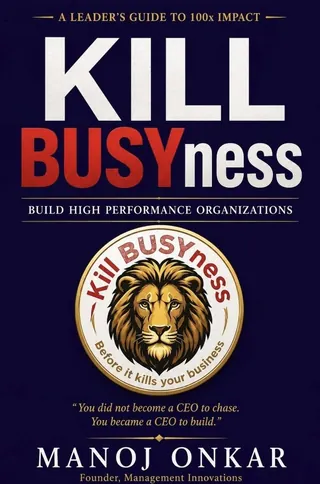
Management Innovations — Vision to ImplementationKILL BUSYness — the book, front cover
KILL BUSYnessKILL BUSYness

← All Chapters

Chapter 03 · ROAR: Reflect

Strategy

As strategy scholar Roger Martin argues, most organizations don't have a strategy — they have a plan: well-constructed, endlessly discussed, referenced every quarter, and comforting precisely because it never requires anyone to give anything up. A real strategy is a set of interconnected choices, and a genuine choice costs something by definition. BUSYness is frequently the direct consequence of avoiding that cost — when everything is a priority, nothing is, and the organization ends up active everywhere and decisive nowhere. Drawing on Michael Porter's work, the book distills strategy into three questions every leadership team must answer with real rigor: which customer segments do we choose to serve, which of their needs do we choose to serve, and how do we serve those needs in a way that creates a long-term competitive advantage competitors can't easily copy? Answering these deeply — until clients respond with genuine surprise at how well you understand them — and aligning every decision behind the answers, is what it means to become a strategy-focused organization. One of BUSYness's most dangerous effects is that it hides the absence of strategy. An organization can stay in constant motion — meetings, budgets, reviews — for years while its competitive position quietly erodes, because full calendars give no signal that none of the activity is moving the organization toward anything. The book calls this the Incumbent's Dilemma: the very things that made an organization successful become the box it can't see beyond. Three Indian case studies make the pattern vivid. A dominant electronics manufacturer, facing Samsung and LG's entry in the late 1990s, diversified into unrelated ventures instead of doubling down on R&D — and lost the market it once owned. Hindustan Motors, whose Ambassador had ruled Indian roads for fifty years, refused to meaningfully innovate against the Maruti 800 and ceased production by 2014. HMT dismissed Titan's quartz watches as "a fad" in 1987 and shut down entirely by 2016. In each case, the company went strategically bankrupt years before it went operationally bankrupt. The most important word in strategy is "no" — saying no to many good ideas so you can say a meaningful yes to one. The chapter's central story follows Mohit Sharma, a lean-management consultant running five different businesses at once, all underperforming, each pulling focus from the one where he had real expertise. Choosing to shut down everything except lean consulting was, in his words, "terrifying" — and fourteen months later he found himself quietly drifting back, taking on "just one" unrelated program. A direct conversation forced a deeper choice: not just lean consulting, but lean consulting for one specific client profile only. The discipline was brutal, and the result was unambiguous — his business grew 15x in two years, and clients who wouldn't previously take his call were now paying more for a single engagement than his entire revenue from running five businesses. That is the counterintuitive pattern the book keeps returning to: as focus narrows, trajectory accelerates. The three strategic questions are never answered once and filed away — high-performance organizations return to them regularly and fine-tune the answers as the market moves. But a clear strategic choice without the competency to execute it is only a well-written intention, which is exactly the gap the next chapter, the Competency Chain, addresses. The chapter closes with the same three questions posed as a direct exercise for your leadership team: which customer segments are you actually choosing to serve, which of their needs are you choosing to serve, and how will you serve those needs in a way that builds a long-term competitive advantage? The Mirror Question sharpens the discomfort: is your organization idea-focused rather than strategy-focused, and are you genuinely willing to say no to some good ideas in order to become strategy-focused instead? Mohit's story is deliberately left with its hardest edge intact — even after committing fully once, he found himself drifting back fourteen months later, because growth itself creates gravitational pull toward compromise. The lesson the book draws from Hindustan Motors, HMT, and the electronics manufacturer that lost to Samsung and LG is the same lesson: strategic bankruptcy is silent and happens years before anyone can see it in the numbers, which is exactly why BUSYness — constant, visible motion — is such effective cover for its absence.

Could every member of your leadership team independently name the same three strategic priorities, right now, without checking a slide?

Log in to save your private reflection and earn XP.