
Sustaining Greatness
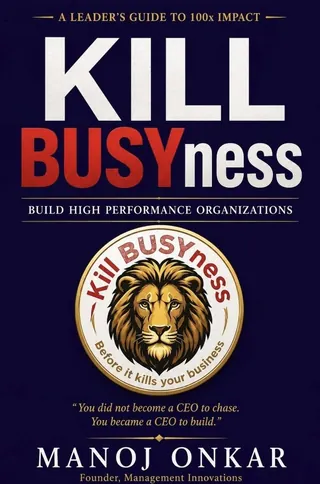
Excellence is not a destination — it is the discipline of never mistaking an achievement for an arrival. Five years into full commitment to this work, the pattern across the leaders profiled in the book is consistent: revenue more than tenfold, profitability more than fifteen times, and — more telling than either number — a leadership team that treats its current success not as something to protect but as the foundation for the next level, and a workforce that carries genuine pride in the organization. The chapter closes with an edited panel conversation among four leaders five years into their transformations: Mr. Kumar (MD, technology services), Ms. Priya Desai (COO, manufacturing), Dr. Raghavan (Chairman, a diversified conglomerate), and Mr. Pandya (MD, manufacturing). Asked what they lost along the way, Kumar admits two people he'd once considered irreplaceable chose to leave once the organization got real clarity on who could genuinely collaborate versus who was optimizing only for themselves. Pandya connects this to recruitment: his company now hires explicitly against KASH — Knowledge, Attitude, Skills, and work Habits — rather than assuming cultural fit will follow domain competence. Raghavan, reflecting on distributing leadership after two decades of centralizing everything around himself, describes the real turning point as the moment his managers started openly arguing with him like partners rather than deferring — proof the organization had matured past needing him in every decision. Desai describes taking the NFR standard seriously enough that her senior team earned NFRL certification within eight months, while extending it into full team- and department-level reliability remains ongoing, harder work. Asked what still demands constant attention even after five years, Pandya calls purpose and strategy "Mount Neverest" — never-rest work — noting that the two monthly reflection days have become more rigorous, not less, as the stakes of drift have grown with the company. Every panelist, without exception, confirms the transformation was never a single decision that stuck — it was a live game the whole way through, with real stretches where it could plausibly have failed. Kumar recalls the first six months as manageable and the next twelve as genuinely uncertain, until two major client wins validated the new strategy and put the company in "a different orbit." Asked for one insight to give a leader starting this journey, the four converge on a shared theme: the commitment itself is the easy part — the harder work is moving the whole team past cynicism into genuine co-creation (Kumar); the follow-up culture was the most expensive thing the organization was doing, invisible until it was actually measured (Desai); no leader is the answer to every question the organization will face, and the sooner a leader embraces dialogue and collective leadership, the better (Raghavan); and two days a month that once felt like an unaffordable luxury turned out to be the single best investment the company ever made (Pandya). The book closes by returning to its opening question — are you building a High-Performance Organization, or a BUSY one? — and to the complete arc of ROAR: Reflect, where you looked honestly into the mirror; Own, where you took responsibility without excuses; Assert, where you set the standard starting with yourself; and Run, where you built the twelve-phase implementation and the standard began to hold on its own. Excellence was never a destination. It is the discipline of never mistaking an achievement for an arrival — and that discipline, now, is yours to carry. The book closes not with a new framework but with a return to its opening question, deliberately unchanged: are you building a High-Performance Organization, or a BUSY one? What has changed, if the work has been done honestly, is not the question but the reader — someone who has looked in the Mirror, owned the reality without excuses, asserted a standard starting with themselves, and begun building something durable enough to run without their constant personal attention. The four panelists close on a shared, almost stubborn note: none of them describe the transformation as finished, and all of them describe stretches where it plausibly could have failed. That is the final, quiet argument of Sustaining Greatness — that the discipline never converts into an achievement you get to stop defending. Now and always, ROAR.
Would your organization's high performance survive twelve months of you being genuinely absent? What's the honest answer, right now?
Log in to save your private reflection and earn XP.