
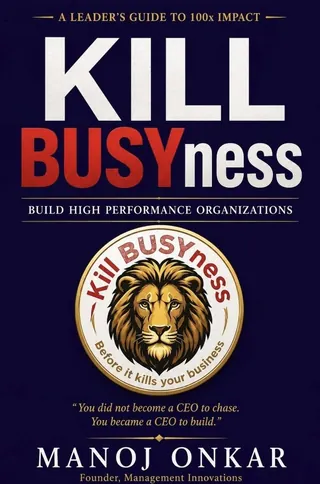
The BUSYness Mirror
Most leaders know something is wrong before they can name it: a week of twelve meetings, hundreds of messages, and three resolved escalations passes, and still nothing they can point to actually moved forward. BUSYness gives the illusion of productivity — full calendars, people in motion — and it follows a predictable cycle. It begins with Unclarity: an unclear purpose, strategy, or set of priorities. Without clarity, people default to Overactivity, reacting to everything that feels urgent because they have no filter for what's actually important. That overactivity spreads the organization thin, producing a lot of motion and little meaningful progress — a gap that breeds frustration and exhaustion. And what do frustrated people reach for? More activity. The cycle restarts. The BUSYness Mirror is simply the discipline of standing back and looking at your organization as it actually is, not as you intend it to be — understanding how clients really experience you and how your best people really experience working for you. Six blind spots reveal themselves once you look: meetings that run on visibility rather than decisions; follow-up as the operating rhythm (in client workshops, senior leaders at a 20,000-person company estimated that 60–70% of their organization's time went to chasing work rather than creating it — a pattern the book calls Dangerous BUSYness Syndrome); standards that drop without anyone noticing, until the lower bar simply becomes normal; people who show up for a paycheck rather than a purpose; the same problems recurring quarter after quarter because symptoms get treated while the underlying system doesn't change; and businesses that survive for generations without ever truly growing. The chapter tells the story of Vikram, the fourth generation of his family's business, realizing in his father's boardroom that the company had "survived" for a century but never actually grown — that BUSYness had quietly filled the space where ambition used to live. By contrast, a High-Performance Organization looks different on every one of these dimensions: meetings produce decisions aligned with purpose and strategy; commitments get honored without anyone needing to ask twice; standards are held, not just set; problems get solved at the system level, not the symptom level; strategy is a rigorous set of choices rather than a plan wearing a strategy's name; and growth is the natural result rather than a constant struggle. Every organization has a BUSYness level. Almost none have measured it. That is the purpose of the BUSYness Index — a simple diagnostic that reveals where an organization actually sits on the spectrum between BUSYness and High Performance, which this portal's Organization Audit turns into a live, measurable instrument for your own team. Whatever your score turns out to be, the fact that you're doing the work to find out already puts you ahead of most. BUSYness is created at the top, normalized in the middle, and suffered at the bottom — which is exactly why the chapters that follow start with the person at the top. The chapter closes with a short journaling exercise built for this exact moment: name the specific signs of BUSYness versus High Performance you notice in your own organization, and name honestly what concerns you about actually addressing them. The Mirror Question that follows is deliberately uncomfortable — where is your organization on the BUSYness Cycle right now, today, not in the version of the story you'd tell a board? The book is candid that BUSYness is created at the top, normalized in the middle, and suffered at the bottom, which means the Mirror has to be held first by the person with the least incentive to look away from what it shows. That is precisely why the BUSYness Index matters as more than a metaphor: a ten-question diagnostic, scored out of fifty, that turns a gut feeling about "how busy we are" into a number a leadership team can actually track, argue about, and improve — the same logic this portal's Organization Audit extends into a full instrument for your own company — from the owner's chair through the leadership team to the wider organization. It's worth being precise about what the BUSYness Mirror is not. It is not a morale survey, and it is not a search for who to blame. It is closer to what a pilot does before takeoff: a deliberate, unemotional check of instruments that are easy to ignore precisely because the plane still appears to be flying normally. An organization can be profitable, growing, and BUSY all at the same time — which is exactly why so many leaders don't look until a competitor, a key client, or a resignation letter forces the question. The Mirror simply moves that moment earlier, while there is still room to choose a different response than damage control.
On a gut-level scale of 1–10, how BUSY is your organization right now — and what specific evidence would you point to for that number?
Log in to save your private reflection and earn XP.