Management Innovations — Vision to ImplementationKILL BUSYness — the book, front cover
KILL BUSYnessKILL BUSYness

← All Chapters

Chapter INTRO · ROAR: Foundation
Reinventing Management

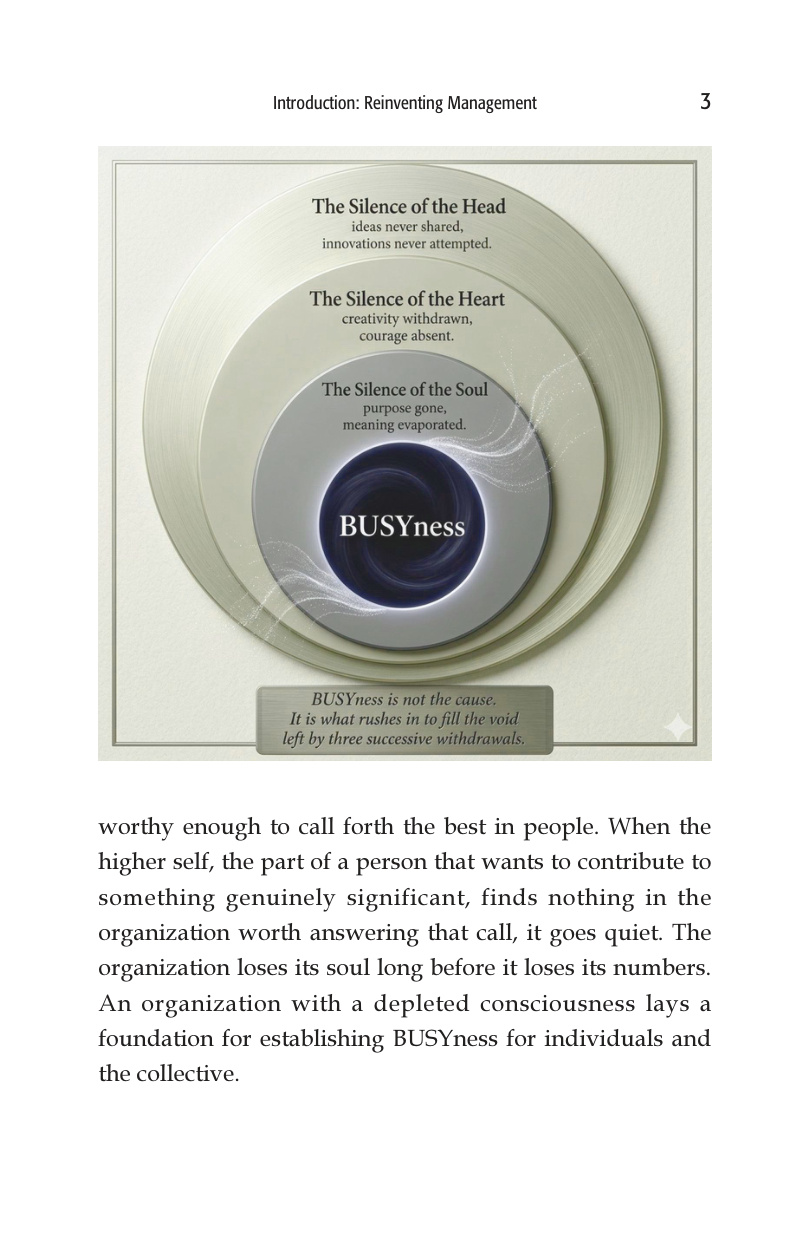
Nearly every management framework of the last century rests on one unexamined assumption: that the job of management is to use resources smartly to get maximum output. Land, capital, technology, people — everything becomes a resource to allocate, use, and replace. We even call people at work "Human Resources," not sources. On the surface this works: output surges, metrics improve, shareholders are satisfied. Beneath the surface, the ground hollows out. That hollowing shows up as three silences. The Silence of the Soul is the deepest: the work doesn't inspire, the game isn't big enough to call forth anyone's best, and the organization loses its soul long before it loses its numbers. The Silence of the Heart is disengagement: without genuine ownership, clarity of role, trust, and authority to decide, people default to compliance — they do what they're told, no more, and over time, less. The Silence of the Head is suppressed thinking: people stop proposing ideas because the culture has already ruled them out, and the organization loses its most valuable asset, the collective intelligence of its own people. Look around your next meeting and count how many people are truly contributing versus merely present — that gap is what extractive management produces. Regenerative management is not a softer version of the same philosophy. It is a different operating philosophy entirely, one that treats people as the source of the organization's future rather than fuel for its present. Extractive management asks, "What can I get from this person?" Regenerative management asks, "How can we co-create?" When Paul Polman became CEO of Unilever in 2009, he abolished quarterly earnings guidance and committed to running the company for all stakeholders, not just shareholders. Over the following decade he delivered nearly 300% in shareholder returns — proof that the shift from extraction to co-creation isn't just more humane, it's more commercially sound. This is the foundation for the ROAR model that runs through the rest of the book: Reflect — confront the BUSYness you have created, allowed, and normalized. Own — take responsibility for your organization's reality without excuses; you are its source, for better and worse. Assert — set non-negotiable standards, for yourself first, then for your leadership team. Run — build a High-Performance Organization that lasts. The journey to High Performance begins with a mirror, and that mirror is where Chapter 1 starts. The chapter ends where the whole book begins: a mirror question, not an answer. Are you running an extractive organization or a regenerative one — and how would the people who work for you actually answer that, if asked privately? The Introduction doesn't ask you to feel guilty about a century of management orthodoxy you didn't invent. It asks you to notice that you've inherited it, that it's largely invisible precisely because it's normal, and that noticing it is the only way ROAR can do its work. Everything that follows — the Mirror, Purpose, Strategy, the Competency Chain — is really this same question, applied one layer at a time, until "resource or source" stops being a philosophical debate and becomes the operating choice you make with every person in your organization, every day. Consider what "sourcefulness" looks like in practice, since the book is careful not to leave it as an abstraction. It shows up in a meeting where someone disagrees with the CEO and is genuinely listened to rather than merely tolerated. It shows up when a frontline employee proposes a change to a process no one asked them to examine, because they trust the idea will be heard on its merits. It shows up in how an organization behaves in a difficult quarter, whether it protects its people and its standards or quietly sacrifices both to protect the numbers. None of this requires a bigger budget. It requires a leader willing to ask, honestly, which philosophy is actually running underneath the org chart — and that honest asking is the whole of what Reflect, the first move of ROAR, requires.

Where in your own language do you still talk about people as a "resource" rather than as a source? What would change if you spoke of them the other way?

Log in to save your private reflection and earn XP.